Question 1 [20 marks]
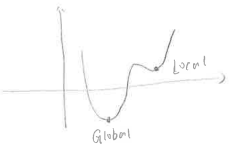
(a) Describe the meaning of local and global minimum using hypothetical examples and plots. [5]
A local minimum is a in some localised region of . Essentially a minimum point in a subsection of a function
A global minimum is a minimum of some design variable(s) across the entirety of a function
(b) Consider the maximisation problem:
Starting at , perform three updates using steepest descent method with a constant step size . [10]
= 1.8
(c) Consider the following optimisation problem: design a cantilever beam with a rectangular cross-section (Fig. 1) with the minimum possible mass. The beam’s mass is given by
where , , and are the dimensions of the beam as shown in the figure below and kg/m is the material’s mass density. We want the deflection of the beam under N to be restricted below 5 mm, where the deflection is given by , where GPa. All dimensions need to be positive. State the objective function(s), the state vector, the dimension of the problem and any constraints. You do not need to solve the problem or derive any necessary/sufficient conditions. [5]
Constraint 1:
Constraint 2:
Objective function:
State vector:
Question 2 [20 marks]
(a) Consider the following objective function
Find its stationary point by solving the necessary conditions. Check whether this stationary point is minimum, maximum, or a saddle point. [6]
and , ,
since our eigenvalues are positive or negative, we are at a saddle point
(b) Can we use the steepest descent algorithm to numerically find a saddle point? Explain why? [4]
Nope, we are only looking to go in the direction of negative gradient, but if we get close to the saddle point, our function will naturally move away, as by definiton, the saddle point is a maximum along one dimension.
(c) Consider the objective function . Show that the point satisfies the necessary conditions. Calculate the condition number of the Hessian at this point. [10]
At
so both are positive, meaning that we have a minimum turning point
Question 3 [20 marks]
(a) When an incompressible isotropic material with shear modulus is stretched in one direction by a pressure , its total energy can be written as:
subject to an incompressibility constraint . Assume and . Write the necessary condition(s) to find the minimum of by using:
- method of reduction (eliminating )
- method of Lagrange multiplier [10]
Condition
(b) Consider the following least square problem:
subject to and
What are the Karush–Kuhn–Tucker (KKT) conditions for the problem? Describe the meaning of an active constraint. [10]
Question 4 [10 marks]
The problem of finding shortest path between two points and can be framed as a functional optimisation problem. Specifically, minimising the functional
For the general objective function , describe the steps that lead to the Euler–Lagrange equation:
Apply the Euler–Lagrange equation to the specific problem of shortest path above and show that must satisfy
Point out the associated boundary conditions. [10]