Mental contacts are used to connect devices electrically, Generally formed by physical deposition
- Evaporation of metal by heating, RF induction, E-beam
- Under vacuum to inhibit metal oxide & nitride formation
Schottky Contact
Forms when the metal work function is larger for the metal than for the (doped) semiconductor Carrier diffusion leads to potential barrier formation equal to difference in work function (Schottky barrier)
- This leads to diode like behaviour
- Most of the time we don’t want this
Ohmic Contact
Forms when the metal work function is lower for the metal than for the (doped) semiconductor
- Now there is no diffusion barrier
- Behaviour of the contact is ohmic, like a resistor
Ideally we want this resistance to be low, to minimise the series resistance of the device
- Contact resistance is a figure of merit
What makes an ideal contact
- Low contact resistance
- Ease of formation via deposition, etching
- Ease of compatability with base processing (cleaning etc)
- No diffusion of metal into base or oxide
- No unwanted reaction with base or oxide
- No impact on the electrical characterisation of the junciton
- Long term stability
Aluminum works really well for Silicion, but III-V alloys like GaAs commonly use gold or platinum
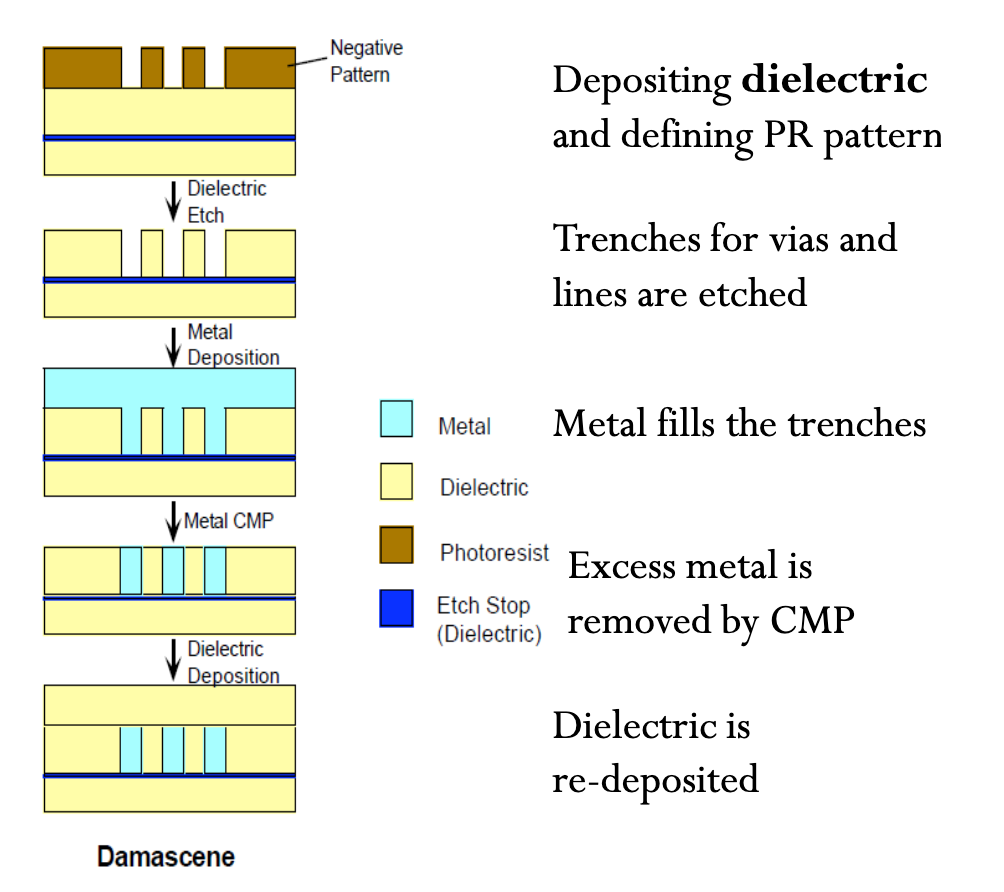
Copper Contacts & Damascene Process
Copper has been replacing Al for Silicon processes because:
- Lower Resistivity → Lower RC delay
- Lower Electromigration → higher life time
- Fewer hilocks → Less shorts between levels However some issues are:
- Cant be dry etched → CMP/Damascene needed
- Cu contaminates Si → Barriers are needed, Ta, TaN, TiN, TiW
- Sticks poorly to
Damascene and Chemical Mechanical Polishing