In a RIE machine with the large electrode A and smaller electrode B. Typically we actually have a sine wave but square wave demonstrates the idea clearer.
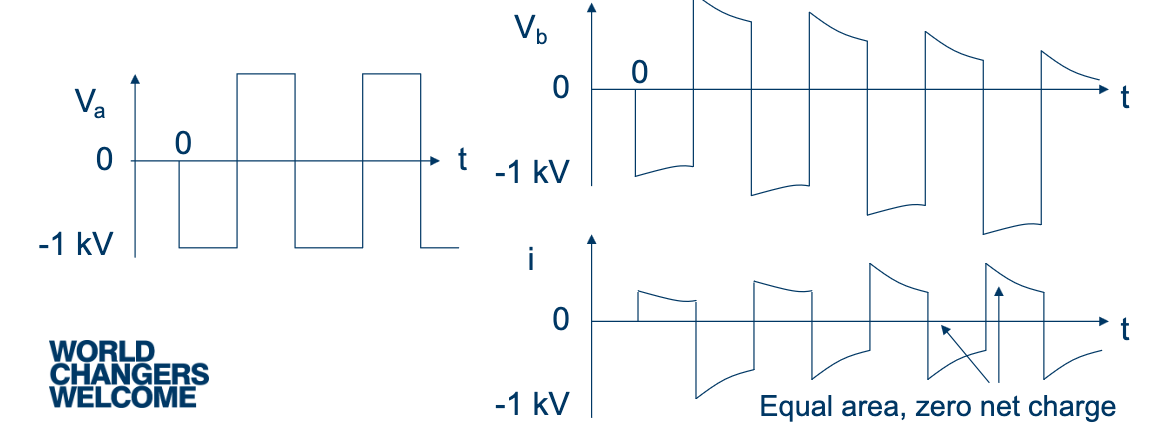
At a high frequency, the increase in Vb will not be much before the voltage reverses and Vb increases. The driven electrode now attracts electrons, and the electron flux in much higher than the earlier ion flux. Vb is driven more negative (towards zero) much more rapidly. Va then switches negative again and Vb becomes more negative then before.
This will repeat, with the electrode gradually becoming more negative over each cycle. Eventually Vb will be negative most of the time, stabilising so that the net negative and positive charge deposited at the electrode per cycle is zero.
After a few cycles, the voltage Vb an hence the voltage across the plasma is strongly negative. The steady state (or DC) part of the voltage is known as the self bias voltage Vdc. If the transit time for an ion across the cathode dark space is longer than one rf cycle (this is true for low density plasmas at 13.56 MHz), the energies of the ions arriving at the surface is given by the time averaged voltage.
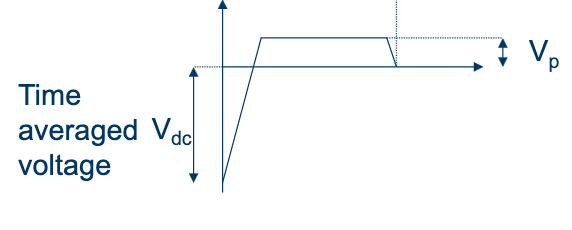
So ions have been accelerated across the cathode dark space, ariving at the driven electrode with energy e(Vp + |Vdc|). Ions leaving the plasma and arriving at the grounded walls of the etcher have energy , usually a much lower energy.