Cleanrooms are required because particles in the air can land on our microdevices and destroy components they touch
Anatomy
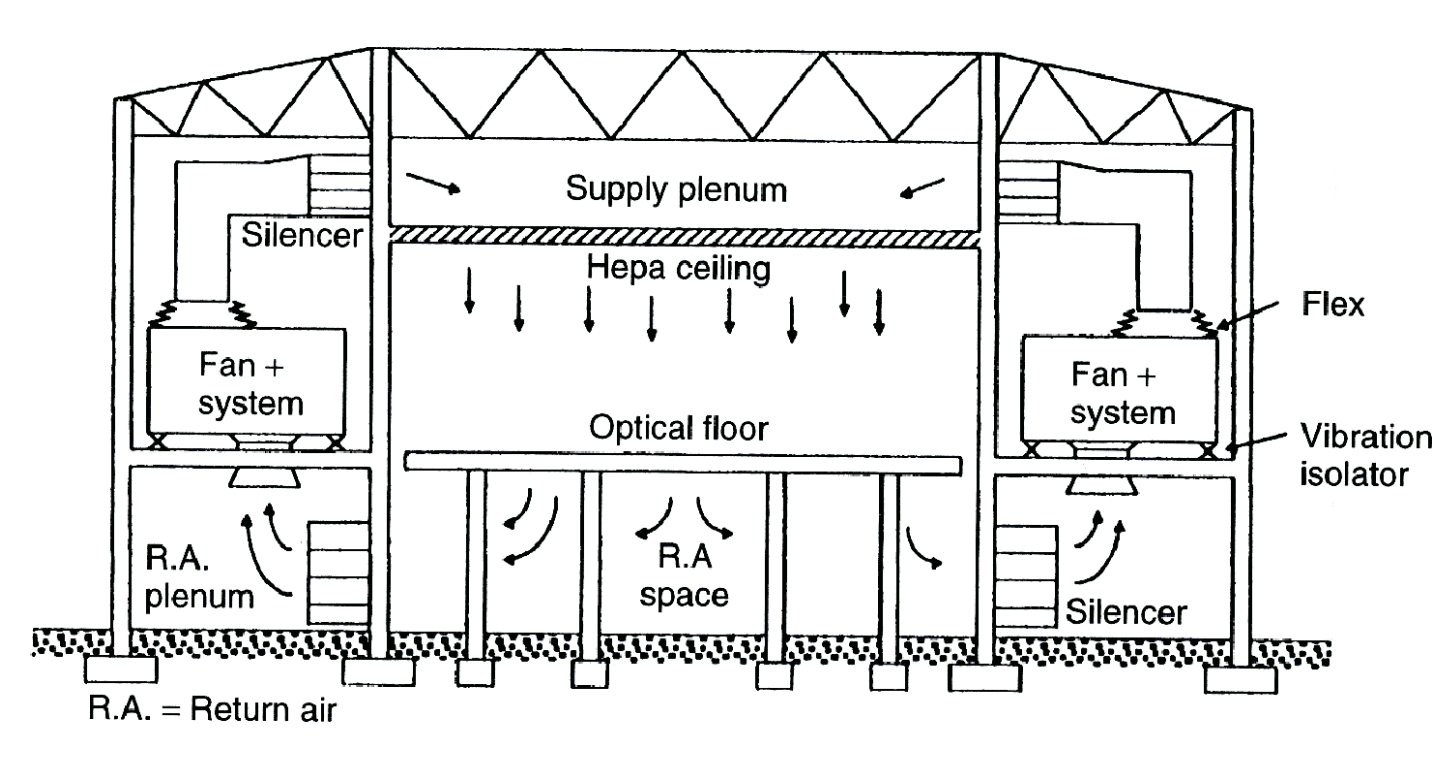
- The air entering a cleanroom is filtered to exclude dust, and the air inside is recirculated through high-efficiency particulate air (HEPA) and/or ultra-low particulate air (ULPA) filters to remove internally generated contaminants.
- Staff enter and leave through airlocks (sometimes including an air shower stage), and wear protective clothing such as hoods, face masks, gloves, boots, and coveralls.
- Equipment inside the cleanroom is designed to generate minimal air contamination. Only special mops and buckets are used. Cleanroom furniture is designed to produce a minimum of particles and to be easy to clean.
- Common materials such as paper, pencils, and fabrics made from natural fibers are often excluded, and alternatives used. Particle levels are usually tested using a particle counter and microorganisms detected and counted through environmental monitoring methods.
- Most cleanrooms are kept at a positive pressure so if any leaks occur, air leaks out of the chamber instead of unfiltered air coming in.
Hazards
- Chemical: Many acids, solvents, bases used in additional to process gases.
- Threshold Limit Values (TLV) are the maximum airborne level of hazardous material that a worker can be exposed to in a working day.
- Immediately Dangerous to Life and Health (IDLH) – self-descriptive
- Electrical: High voltage machines and apparatus
- Thermal: Hot-plates, cryogenic systems
- Optical hazards: Lasers and UV sources used in lithography / metrology
Example
Question
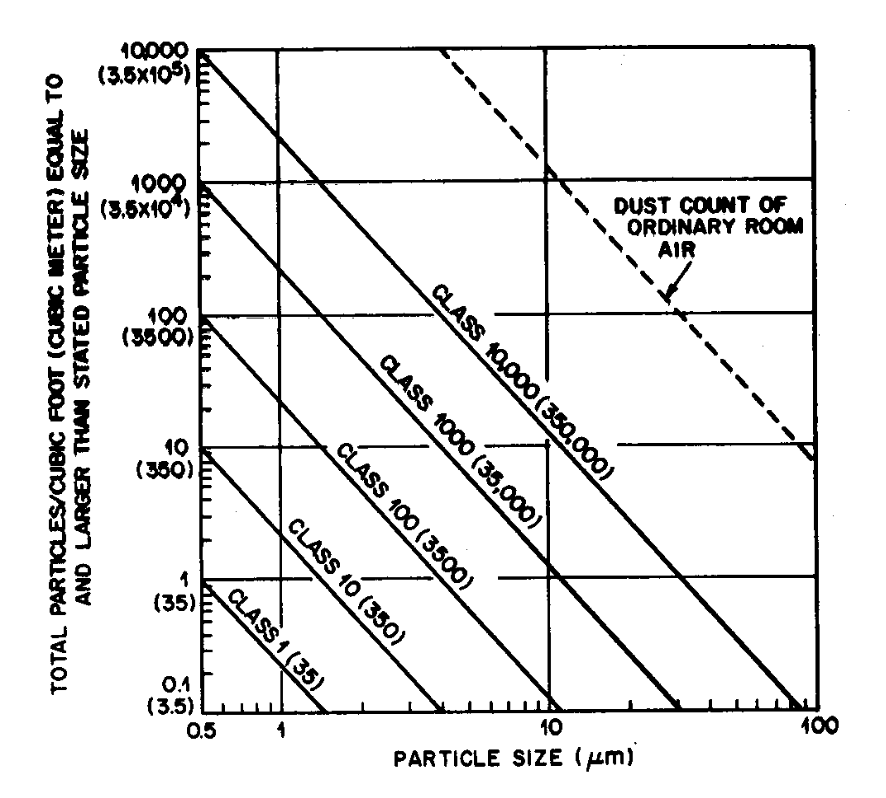
If a 100 mm diameter wafer is exposed for 1min in an air stream at 30 m/min under laminar flow in a Class 10 clean room, estimate how many particles of size greater than 0.5μm might land on the wafer
Answer
Volume/min = Area x Flow rate Area = No of particles = particles/ x Area x Flow rate = particles on the wafer
Question
If a 100 mm diameter wafer is exposed for 1min in an air stream at 30 m/min under laminar flow in ambient room air, estimate how many particles of size greater than 0.5μm might land on the wafer.
Answer
Extrapolate Graph…… 105x more (>0.5um) particles may now stick to the wafer → 8,200,000 particles If this is a laser wafer containing ~50,000 devices → ~ over 150 particles per device! (yield ~ 0%)