-
Epitaxy
- Growth of a single crystal film on top of a crystalline substrate
- Film A is grown on a substrate B
-
Homoepitaxy
- Film and the substrate are the same material, e.g.
-
Heteroepitaxy (most common)
- Film and substrate are different materials, e.g.
-
Pseudomorphic growth (very common)
- Lattice constant of film and substrate different, but coherently strained growth: In-plane lattice constant preserved (but distorted out-of-plane), e.g.
Crystal Growth Methods
Liquid Phase Epitaxy (LPE)
- Crystal grown from a melt
- Can be used to form heterostructures and doped layers
- Reasonable uniformity and thickness control
- Formerly main method for producing LEDs Vapour Phase Epitaxy
- Growth from the gas phase (liquid or gaseous pre-cursors)
- Metal-Organic Vapour Phase Epitaxy (MOVPE) (= Metal Organic Chemical Vapour Deposition (MOCVD)) most commonly used for photonic devices
- Highly scalable for mass production Molecular Beam Epitaxy (MBE)
- Crystal growth occurs in ultra-high vacuum
- Physical deposition using solid or gas based atomic or molecular sources
- Very high degree of control
- Commonly used in research
| MOCVD | MBE | |
|---|---|---|
| Growth Control | + High growth rates, quicker for thick layers, excellent material quality. - Less suited to very thin layers/many interfaces. - Carbon contamination from precursors. | + Fast composition switching → sharp interfaces and superlattices. + Far-from-equilibrium growth (metastable materials). + High purity. - Challenging for phosphorous-containing layers. |
| Monitoring (in situ) | + Optical reflectance. - Limited other in situ tools. | + Multiple tools available (reflectance, electron diffraction, STM) since it operates in vacuum. |
| Maintenance | + Low downtime. | - Significant downtime, need to bake out system and establish vacuum. |
| Safety | - Hydrogen = explosive risk. - Toxic precursor gases require strict handling. | + Fewer issues (solid sources). - Phosphorous layers pose fire risk. - Requires cryogenic cooling. |
| Throughput | + High throughput, planetary systems enable high volume production. | - Less suited to volume production (but better for some materials, e.g. narrow bandgap semiconductors, quantum dots). |
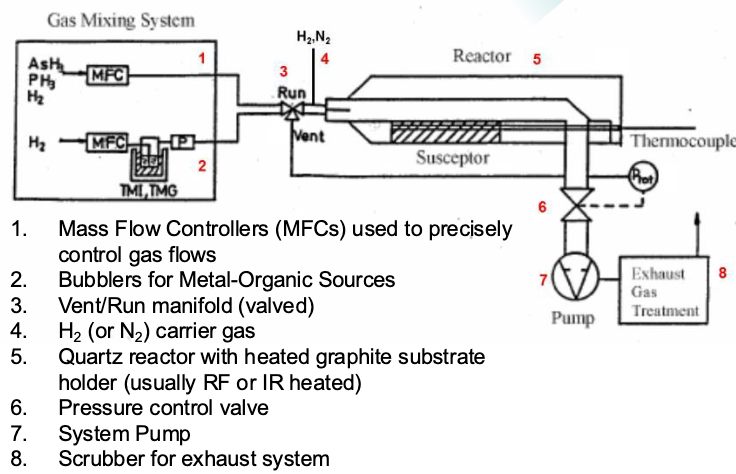
Metal Organic Vapour Phase Epitaxy (MOCVD)
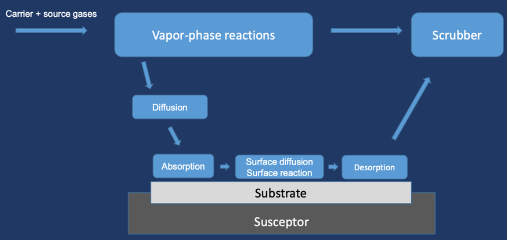
Reacts “precursor” gases above substrate surface which produces atoms of interest which then fall onto surface and cause layer growth
Decomposition very temperature sensitive. Growth temperature (of substrate) typically in the range.