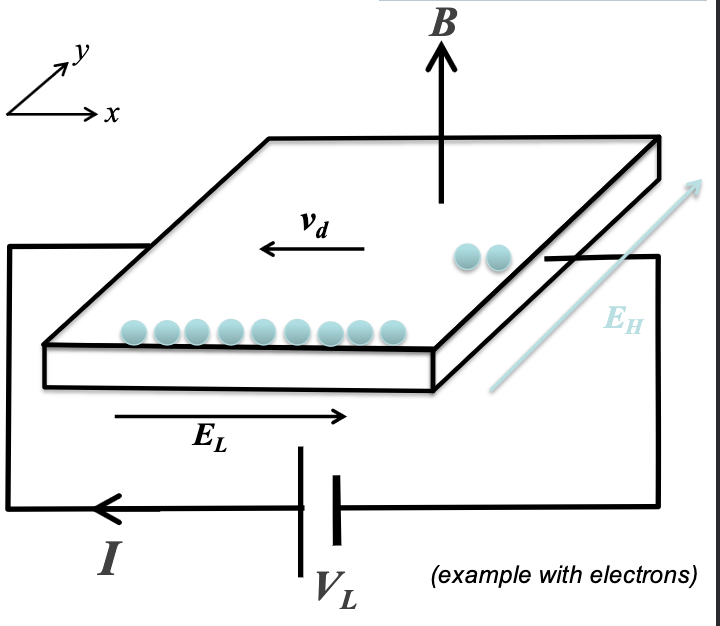
Setup
A voltage is applied to a semiconductor causing electrons to drift with a velocity leading to a current to flow.
If a magnetic field is applied perpendicular to the plane, the Lorentz force acts on the electrons causing them to move towards one side.
This gives rise to a perpendicular electric field, the Hall field which opposes the Lorentz force and stops further electrons from being deflected.
In equilibrium the force due to the Hall field field equals the Lorentz force, hence: (since vectors are perpendicular)
or
Thus, by measuring and (or ) as a function of , we can determine the carrier density,
NB: The sign of also tells us the type of carrier (electron or hole)
So by measuring we can determine the carrier density and by measuring the resistance we can also determine conductivity as and
Using this we can determine mobility since
We also note here that i.e. the magnitude of the Hall voltage depends on the magnetic field, the width of the material (i.e. physical size) and the drift velocity
From before, so materials with a high mobility will give rise to higher Hall voltages
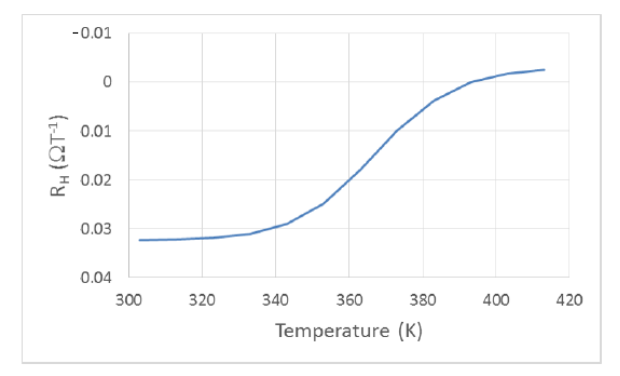
Temperature Dependance