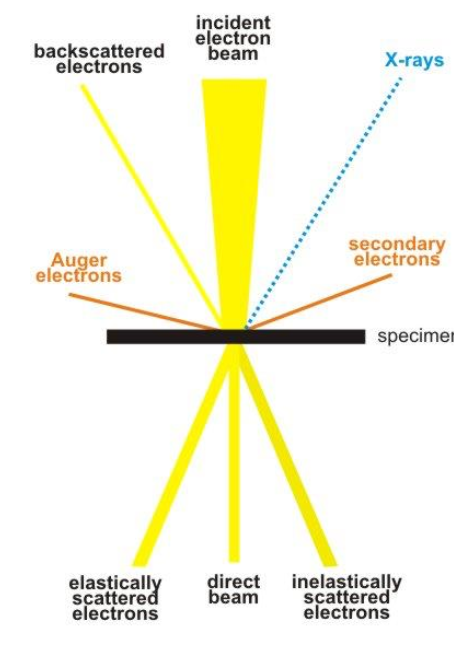
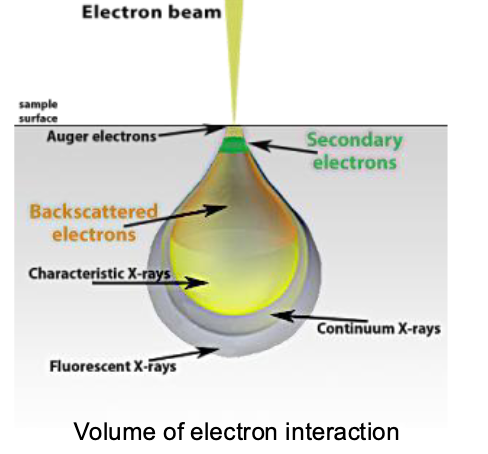
 This shows the interaction volume — the teardrop-shaped region beneath the sample surface where an incident electron beam interacts with the material. Different signals originate from different depths within this volume:
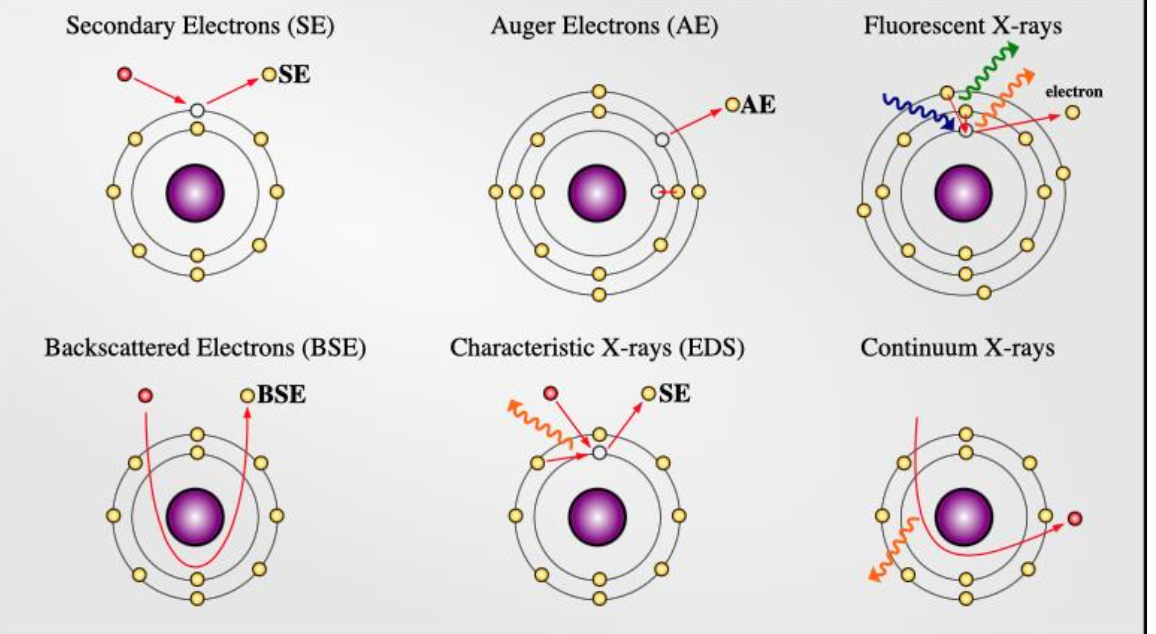
- Secondary electrons — from the very top surface (~few nm). Low energy, easily absorbed, so only the ones generated near the surface escape. Give topographic contrast.
- SE1 are generated direct on entry, high res signal, limited only by beam diameter
- SE2 are generated by backscattered electrons coming back to surface. Resolution poorer than SE1 More SE2 are generated as atomic number (Z) increases, especially at lower beam energy.
- Auger electrons — also from very near the surface (~1-2 nm). Used for surface composition analysis (Auger electron spectroscopy).
- Backscattered electrons — from deeper in the interaction volume. High energy beam electrons scattered back out. Compositional (Z) contrast.
- Most are generated as BSE2
- Characteristic X-rays — from deeper still. Inner shell electrons are knocked out by the beam, and the resulting electronic transitions emit X-rays at element-specific energies. This is what EDX/EDS analysis detects.
- Continuum X-rays (Bremsstrahlung) — produced when beam electrons decelerate in the Coulomb field of nuclei. Broad spectrum, forms the background in EDX spectra.
- Fluorescent X-rays — from the deepest/widest region. Generated when characteristic X-rays from one atom are absorbed by and cause emission from neighbouring atoms. Limits spatial resolution of X-ray analysis.
The key takeaway is the trade-off: surface-sensitive signals (SE, Auger) give better spatial resolution since they come from a small region, while deeper signals (X-rays) carry compositional information but from a larger volume, degrading spatial resolution.
Elastic vs Inelastic Interactions
- Elastic Interactions No energy is transferred from the electron to the sample. The electron either passes without any interaction (direct beam) or is scattered by the electrostatic attraction of the positive potential inside the electron cloud. The arising signals are mainly exploited in TEM and electron diffraction.
- Inelastic Interactions Energy is transferred from the incident electrons to the sample producing secondary electrons, phonons, UV quanta or cathodo- luminescence. Ionization of atoms by removing inner shell electrons leads to the emission of X-rays or Auger electrons. These signals are used in analytical electron microscopy.