Homojunction
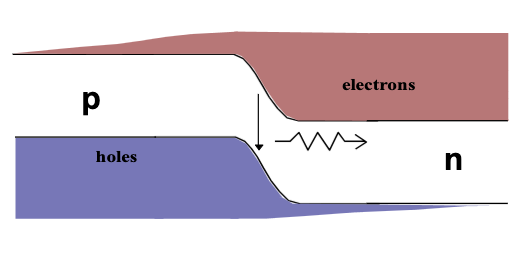
Uses a simple diode. Has poor confinement of holes and electrons, and poor confinement of photons.
Double Heterostructure
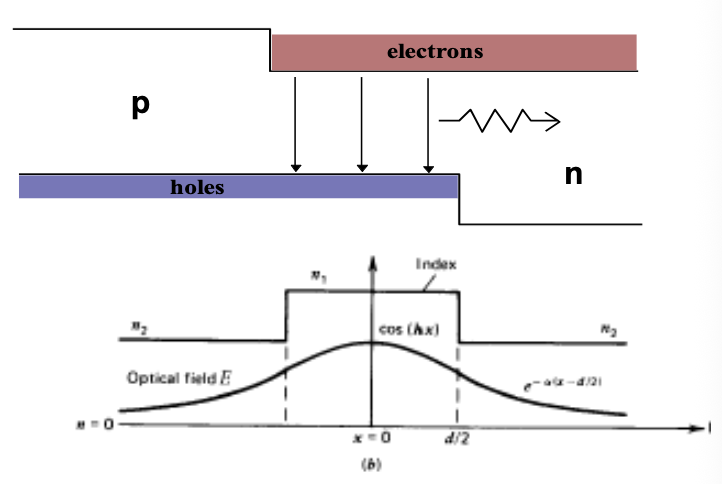
Better carrier confinement using a potential barrier Refractive index difference also improves optical confinement Both make threshold currents and make them more efficient
Quantum Well (QW)
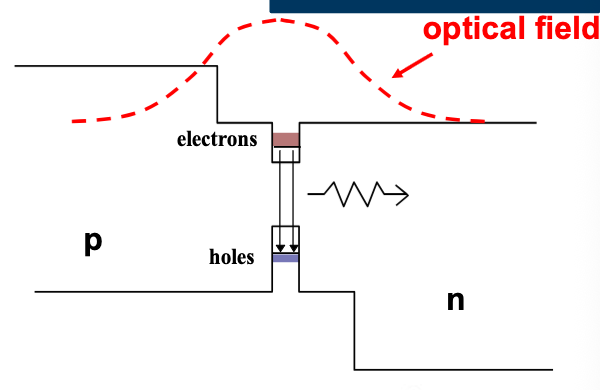 Utilises very thin layers of smaller band gap semiconductor to better trap charge carriers. Uses same double heterostructure for optical confinement.
More flexible for altering the band gap and well width to change the transition energy.
- is the energy of the -th confined state. or
- is the reduced Planck constant. J·s
- is the effective mass of the carrier in the confinement direction (). Accounts for the band structure of the semiconductor — not the free electron mass.
- is the quantum number (). is not permitted — ground state is .
- is the width of the quantum well in the confinement direction.
Energy scales as and as — narrower wells push the energy levels up and further apart. This is the basis of bandgap engineering in heterostructures: by choosing (e.g. in GaAs/AlGaAs quantum wells), you tune the transition energies and hence the emission wavelength.
Note this only describes quantisation in . In-plane (, ) the carriers are still free, so the total energy includes a continuous kinetic energy term in those directions.
Design Considerations
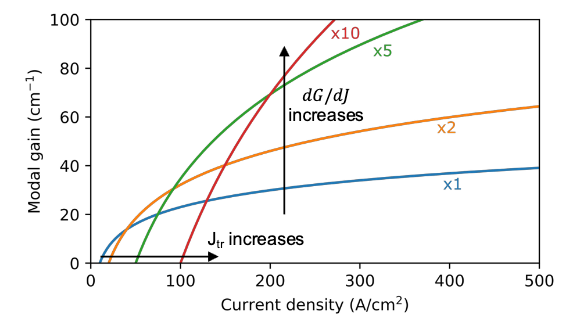
In a single quantum well (SQW) laser, the modal gain is — the material gain of the well scaled by the confinement factor , which is the spatial overlap between the optical mode and the thin QW. Since a QW is typically only ~5-10 nm thick while the optical mode extends over hundreds of nm, is small — so even if is large, the modal gain is limited.
Multiple quantum well (MQW) lasers address this by stacking wells, giving total modal gain . Each additional well contributes its own to the total.
Benefits:
- Higher differential gain () — the gain responds more steeply to current changes. This means faster modulation bandwidth, critical for telecoms applications.
- Can reduce threshold if the increased gain outweighs the additional transparency current.
Trade-offs:
- Each QW needs to reach transparency before it contributes net gain. More wells means more current just to get all wells to the point where stimulated emission exceeds absorption. If the cavity optical losses are low, you didn’t need the extra gain and the added transparency current just increases threshold.
- For large numbers of QWs, carrier uniformity becomes a problem — wells closer to the p-side or n-side of the junction get pumped unevenly, so not all wells contribute equally to gain.
So the optimal number of QWs is a design trade-off between modal gain, threshold current, and modulation speed for the specific application.
Strain
tensile strain (negative) favours TM (Transverse Magnetic) mode emission, while compressive strain (positive) favours TE (Transverse Electric) mode. This is because strain breaks the degeneracy of the heavy-hole and light-hole valence bands, changing which transition dominates. TE (Transverse Electric) — the electric field oscillates in the plane of the QW layers. This is the dominant polarisation for heavy-hole to conduction band transitions. TM (Transverse Magnetic) — the electric field oscillates perpendicular to the QW plane. This is the dominant polarisation for light-hole to conduction band transitions.
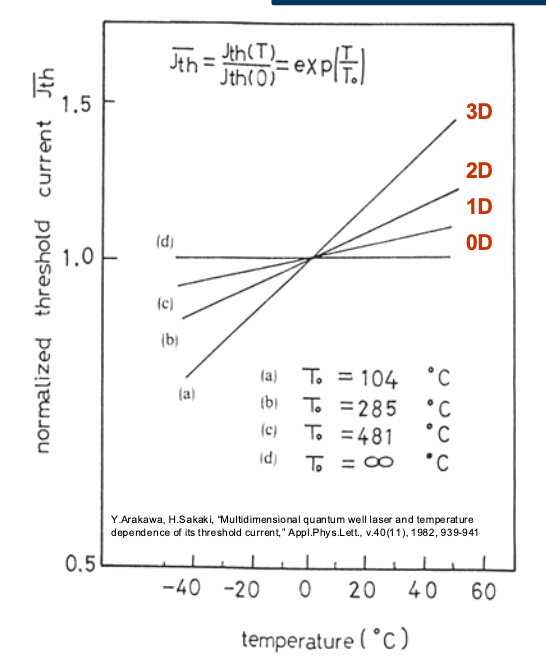
The lower the dimensionality of the laser the lower the tempreature variance