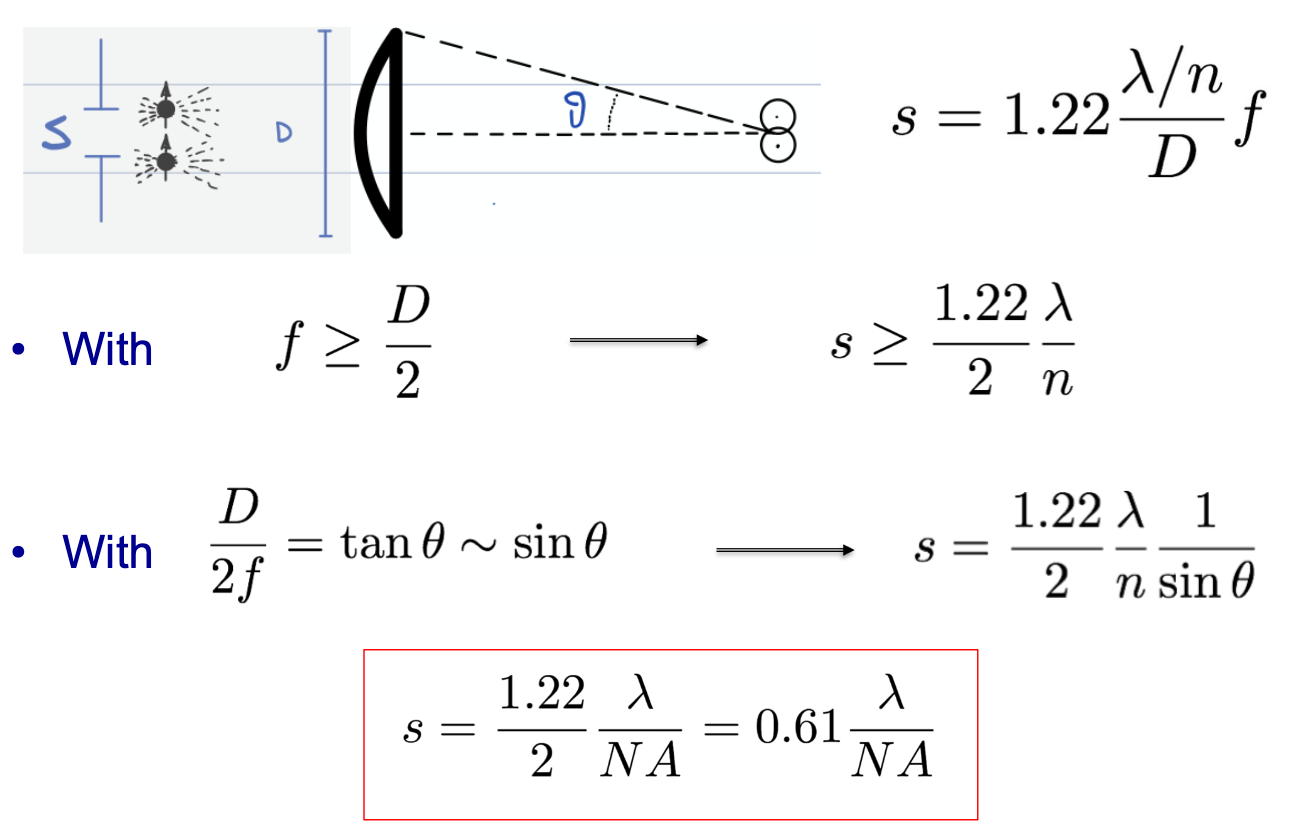
The resolution is the distance at which a lens can barely distinguish two separate objects. Resolution is limited by aberrations and by diffraction. Aberrations can be minimized, but diffraction is unavoidable; it is due to the size of the lens compared to the wavelength of the light.
Coherency
Waves with identical frequency and fixed phase constant difference are said to be fully coherent .
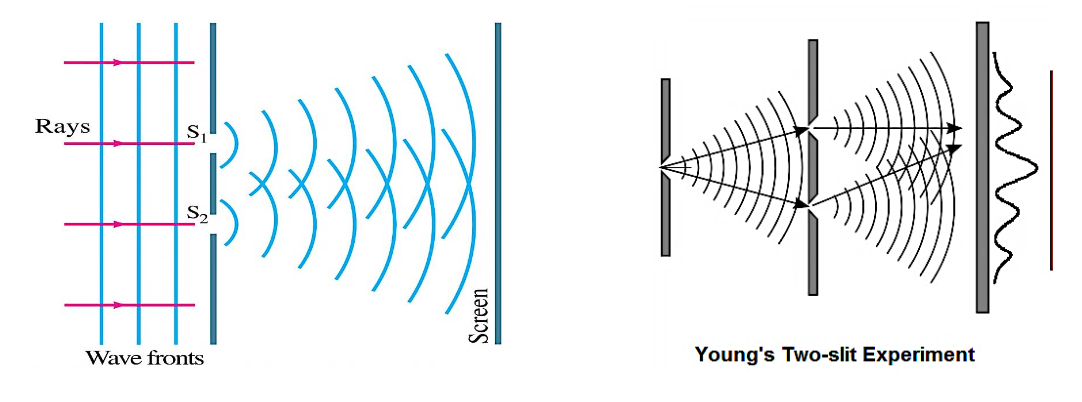
The two slits in figure act as if they were two separate sources of radiation. They are said to be mutually coherent sources when the waves leaving the slits have the same frequency and the same phase relationship to each other at all time.
In the case above, this happens because the waves come from a single source split in two. An interference pattern is observed only when the sources are coherent.
Two sources whose output waves have phases that bear no fixed relationship to each other over time, are called incoherent sources.
Frauenhofer vs Fresnel Diffraction
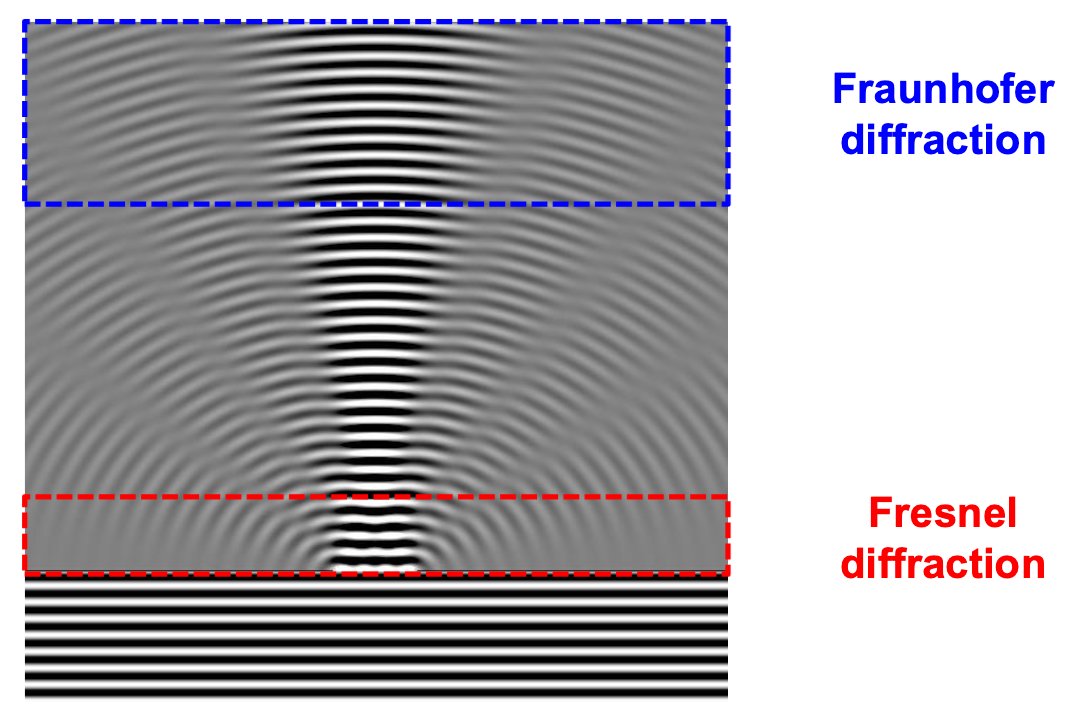
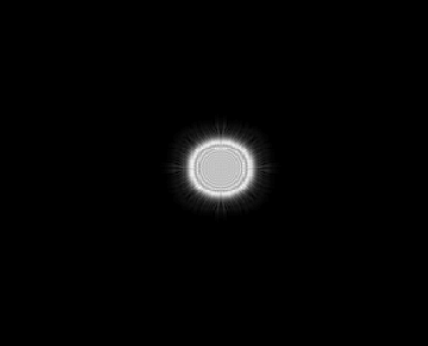
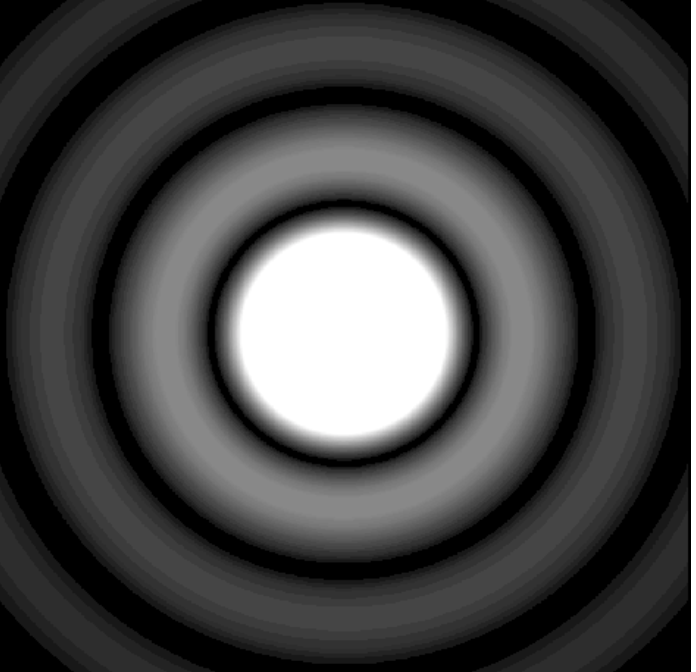
Computer generated light diffraction pattern from a circular aperture of diameter 500 nm at a wavelength of 600 nm (red-light) at distances of 0.1 cm – 1 cm in steps of 0.1 cm. One can see the image moving from the Fresnel region into the Fraunhofer region where the Airy pattern is seen.
Fresnel:
Frauenhofer:
Rayleigh Critereon
The Rayleigh criterion states that two images are just resolvable when the center of one peak is over the first minimum of the other.
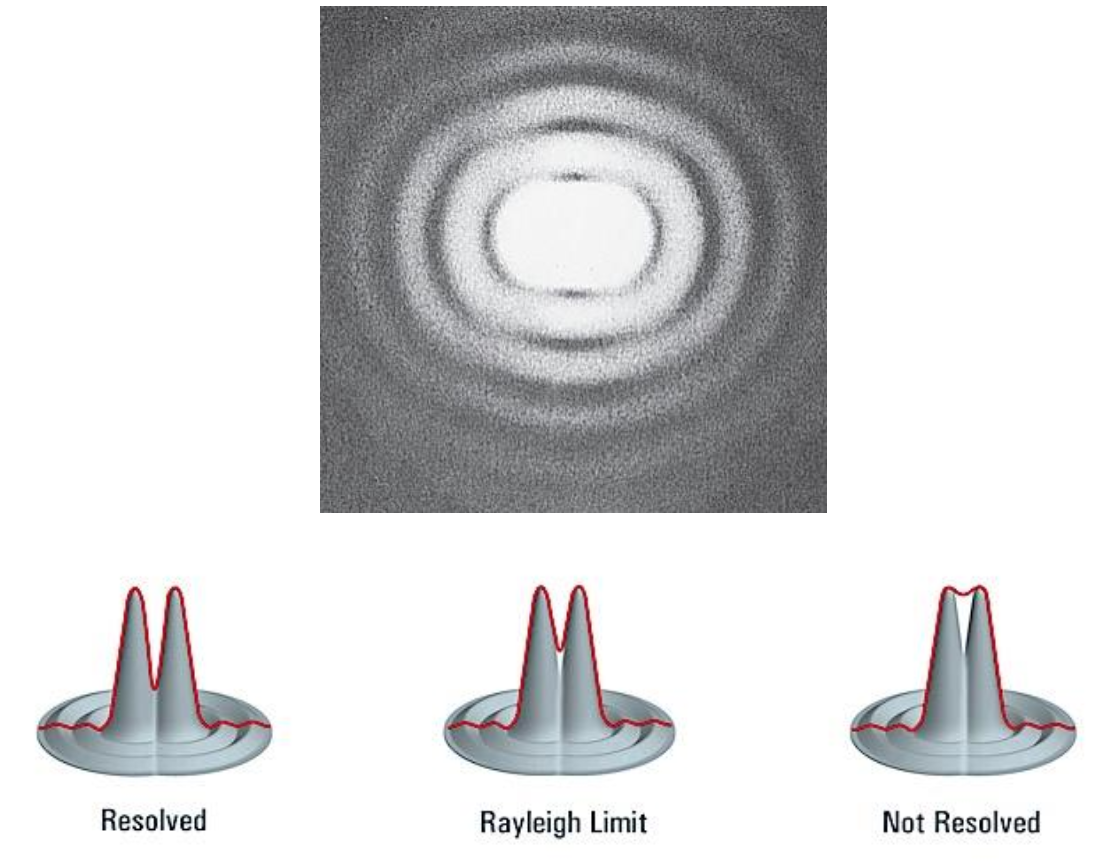
Diffraction sets an ultimate limit of resolution, which restricts the details that can be seen on an object. Since objects are normally placed near the focal point of a microscope objective, the angle subtended by two objects is . We call resolving power () the quantity :
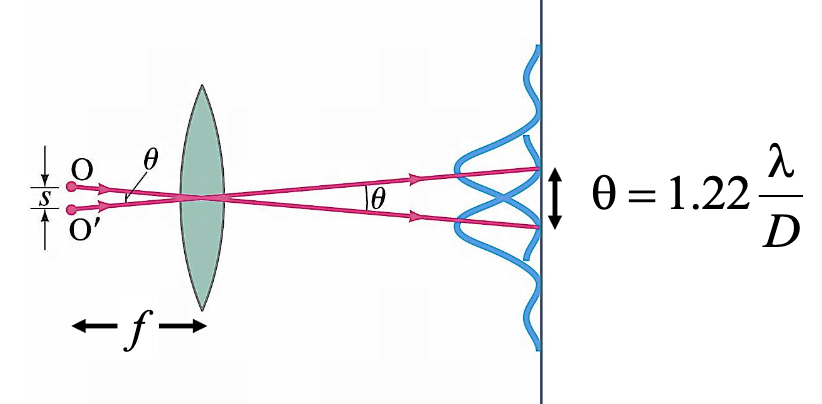
The λ limit
Within a factor of 2 or so, it is not possible to resolve detail of objects smaller than the wavelength of the radiation being used.
Abbe-Rayleigh Resolution Limit