Monochromatic Abberations
Deviations from the idealized conditions set by the paraxial approximation , are called monochromatic aberrations.
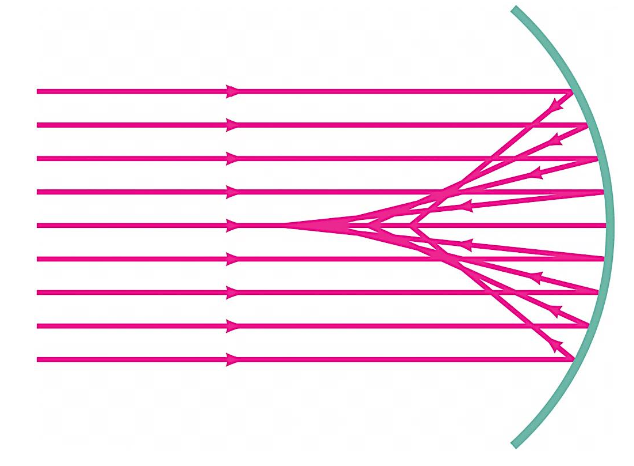
One type of monochromatic aberration is the spherical aberration. Parallel rays striking a spherical mirror do not all converge at exactly the same point if the curvature of the mirror is large.
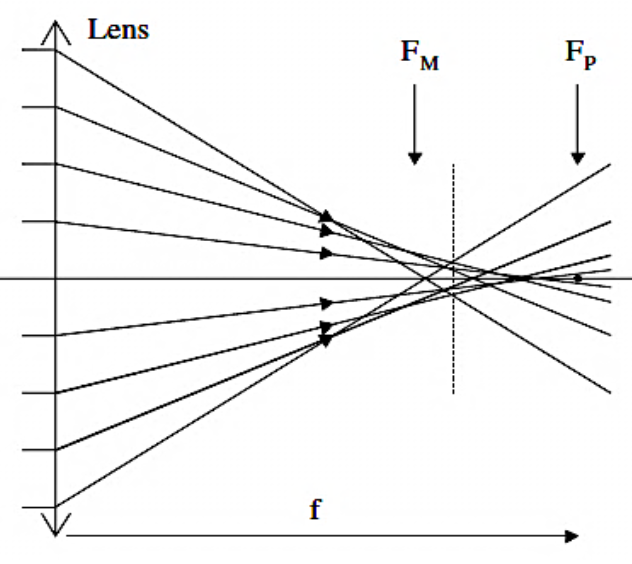
Spherical aberration for a positive lens. The paraxial focus is and the marginal ray focus is .
The broken line indicates the plane of the circle of least confusion.
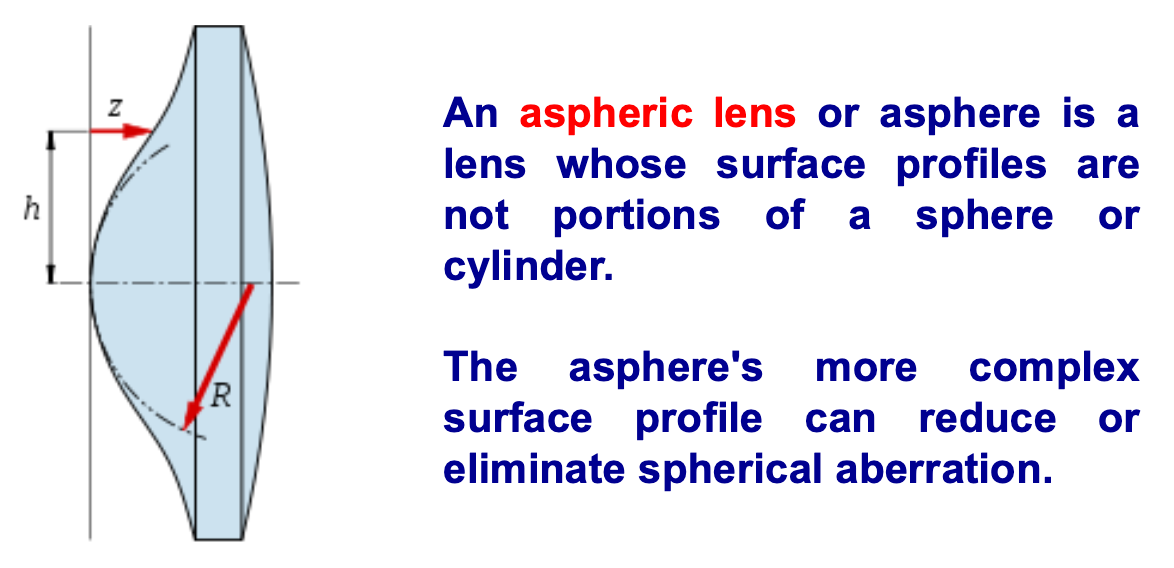
A potential solution:
Chromatic Abberations
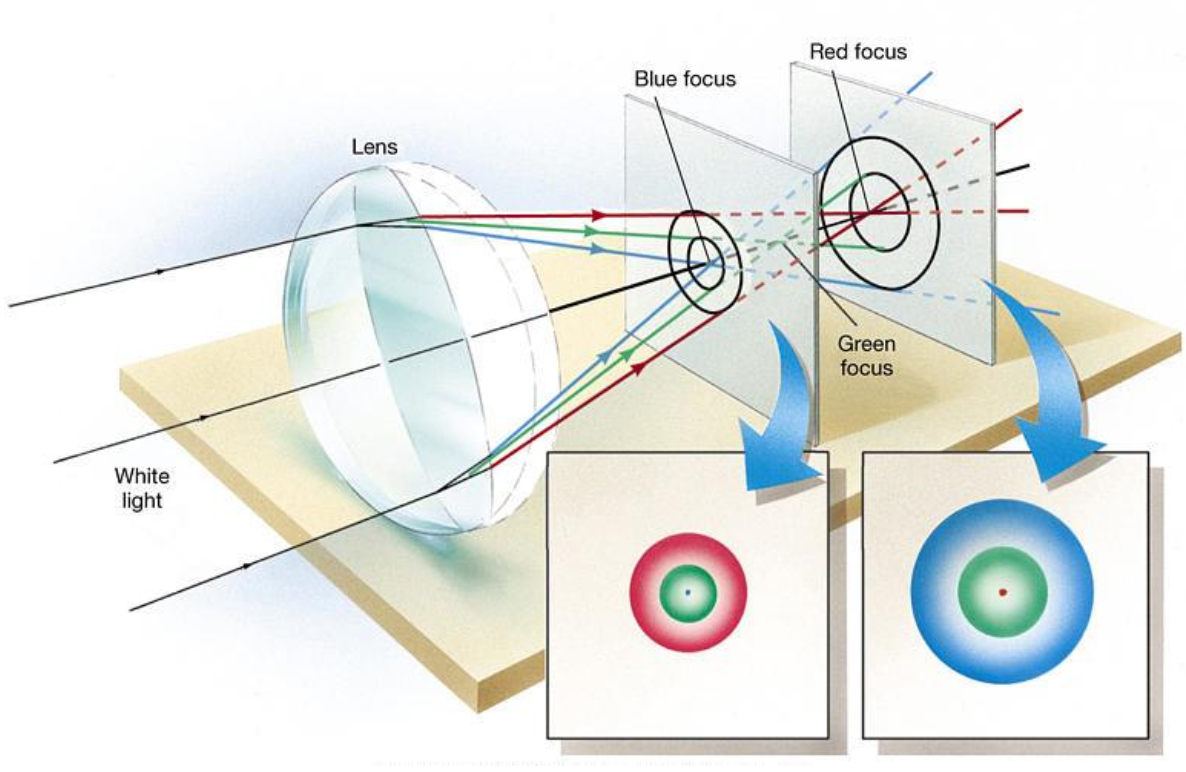
Chromatic aberration is caused by the dispersion of the lens material (the variation of its refractive index, , with the wavelength of light). Since the focal length is dependent upon , it follows that different wavelengths of light will be focused to different positions.
Effects occur for paraxial as well as non-paraxial rays. They do not affect pure mirror systems
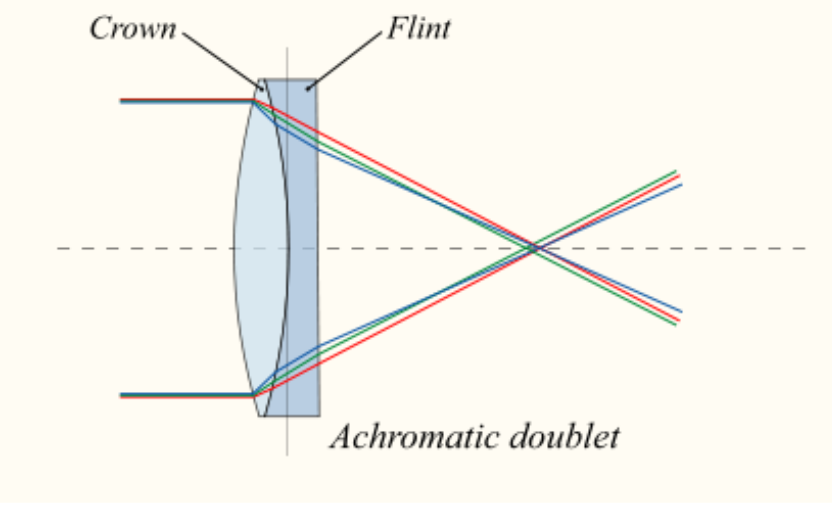
Achromatic Doublet
The most common type of achromatic lens is the achromatic doublet, which is composed of two individual lenses made from glasses with different amounts of dispersion. One concave lens has relatively high dispersion, while the other, convex, has lower dispersion.
The lens elements are mounted next to each other, often cemented together, and shaped so that the chromatic aberration of one is counterbalanced by that of the other.