Dry Etching Damage Events in Plasma Instrumentation for RIE
Reasons to Dry Etch:
- Wet etching gives, in general, an isotropic profile and undercutting of the mask. It also produces a lot of used bulk chemicals that have to be disposed of (expensively).
- As feature sizes diminish, the aspect ratio of the features increases, so control of the etch profile becomes very important.
- Etching using ions gives better control of the profile of the feature. It can be vertical or sloped as required.
- Insitu monitoring of the progress of the etch (end point detection) is much easier in dry etching.
- There is less waste product.
- The yield is higher. Very slight contamination of the surface by oil/grease that would stop wet etching is removed by the action of the ions in dry etching.
- Dry etching is now almost universally used in silicon device processing (In MEMS, wet etching is used for special purposes).
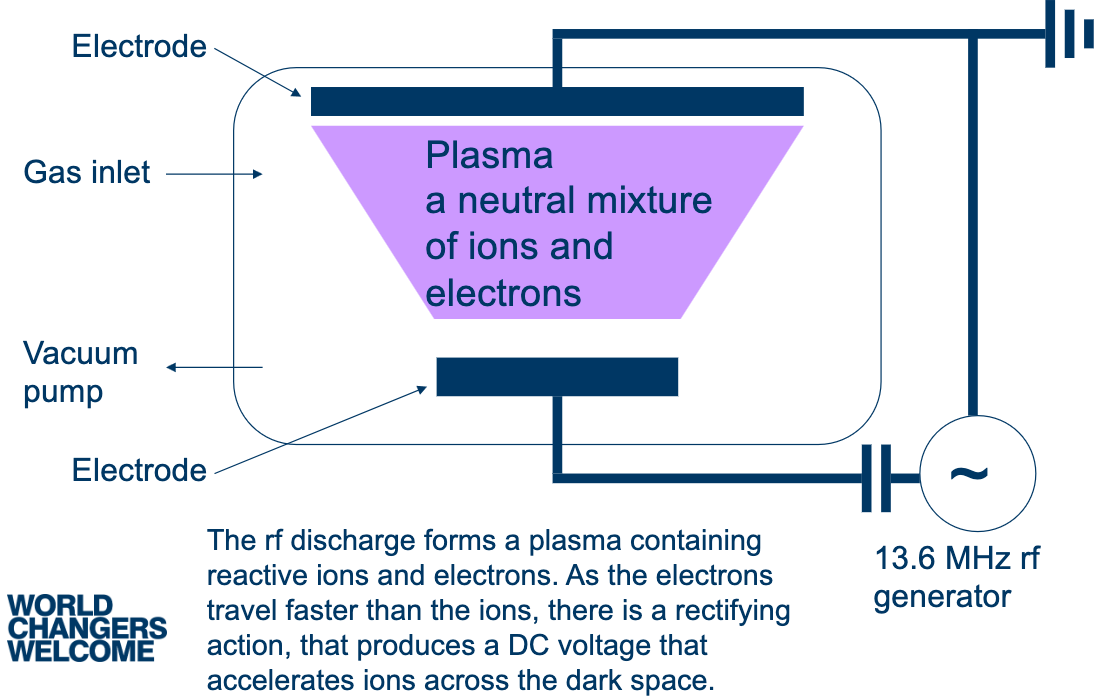
Diagram of a Reactive Ion Etching (RIE) Machine
Reaction Cross-section
Some electrons are close enough to the heavy molecules to be captured and take part in the reaction. This will happen if the electron and the reacting molecule are within an area . The area is called the cross-section of the reaction. Suppose a beam of electrons of flux I is incident on a slab of gas of area and thickness . The flux is the number of electrons per second in the incoming beam. If the density of molecules is N per unit volume, then the average number in the slab is . The number of collisions per second in the slab of gas is
Now the number of incoming electrons per second is , so the probability of a collision in the thickness is **
Gasses Used
Major Constituents
- Halogen containing gasses Directly using halogen gasses damages vaccuum pumps so is typically avoided, more likely to see: etc
- Oxygen burns materials that contain H and C, its used to remove resist, as well as etch polymers
- Methane/Hydrogen is used to form metalo-organic compounds that volatile. This is the opposite of MOCVD. We use this with III-V, II-VI and magnetic metals.
Additives
- Nitrogen Reacts with Carbon and so prevents it recombining with F. Improves F etch rate
- Oxygen Can oxidise the side walls and surface of III-V, increasing the verticality of the etch A lot of the time we get these additives out of the material and mask being etched.
Inert Gasses
- He, Ar (Ne, Kr are expensive) These gasses stabilise the plasma by producing more electrons when they ionise. They do however introduce more physical sputtering as thats the only reaciton they are able to do. This is a problem in III-Vs where we cant anneal the sample to get rid of traps and vacanies
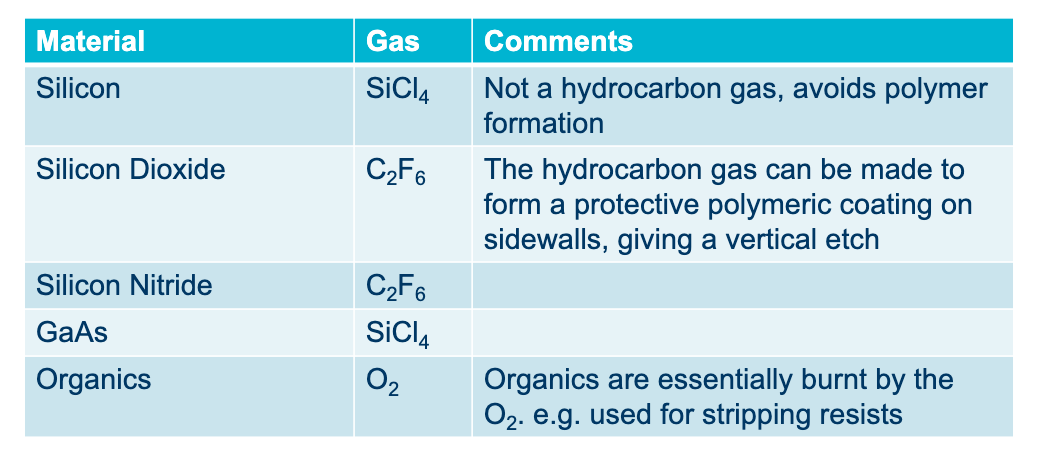
Gas choice table
Desirable features of an etch process
- Suitable Etch Rate Speed is good, but too fast is hard to control
- Selectivity Ideally we only want to etch certain materials, ignoring others. Typically we need to introduce additives to our halogen etching gas to improve selectivity
- Profile Control Most of the time we want vertical etching
Undesirable features of an etch process
- Loading effects Etch rate can be affected by things like aspect ratio, and other things that affect our etch rate are termed as “loading effects”
- Non-uniform etching This can ruin our yield, and is also dependant on the dry etch machine, especially at the edges. Its typically not in our hands as machine users
- Dry etch damage Sputtering, Channeling and such can introduce traps and vacancies, that affect our performance. This is particularly problematic as III-Vs are difficult to anneal which is otherwise the primary solution to this problem